Featured case note · Tax, GST
Taxed as Sold, Not as Served – What Cadila Health Care Means for Classification Disputes
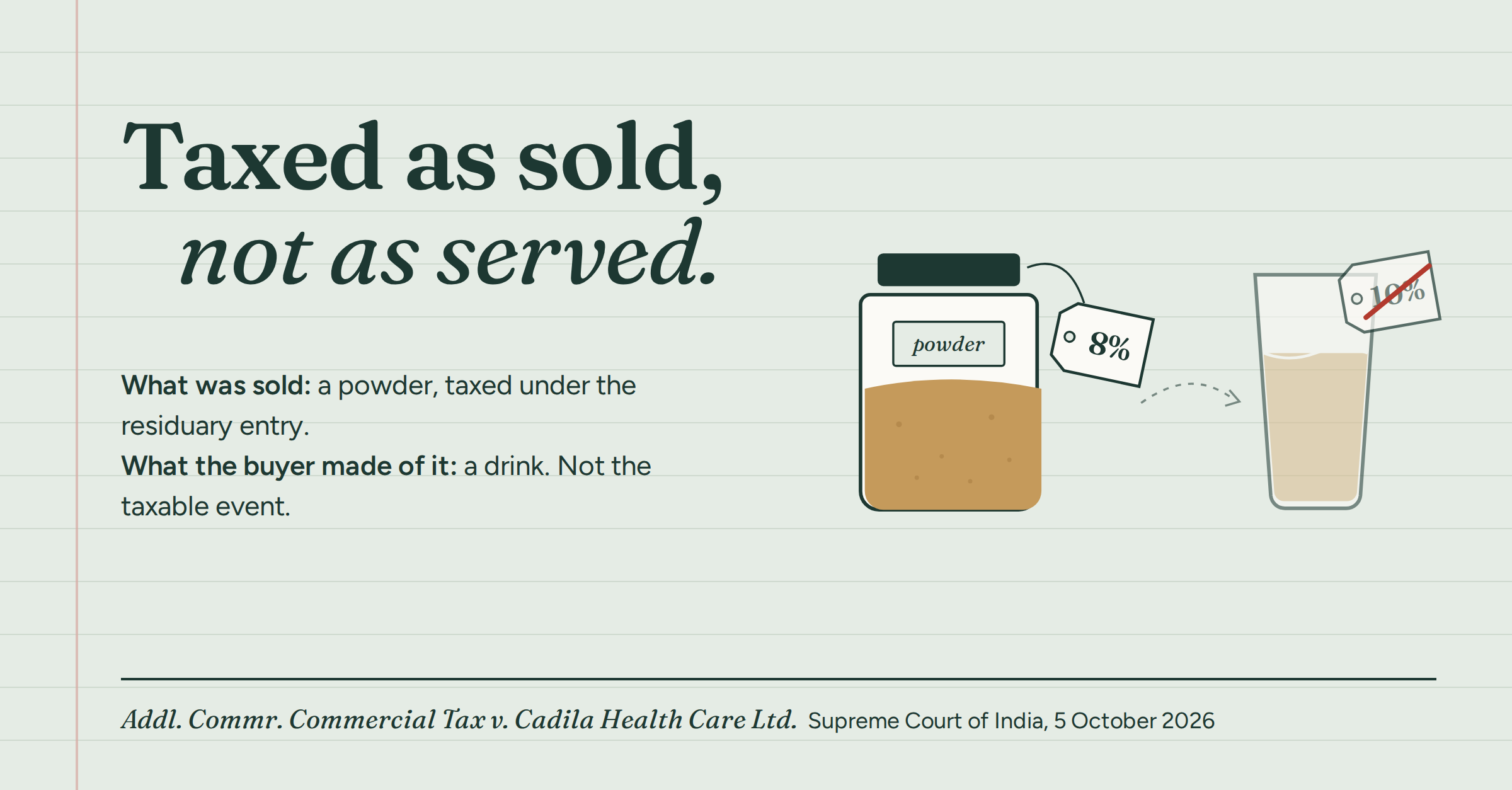
Classification disputes rarely look exciting from the outside. Two entries, a two per cent difference in rate, and a product most of us have seen on a supermarket shelf. But every so often one of them settles a question that keeps coming back in practice, and I think Addl. Commr. Commercial Tax v. Cadila Health Care Ltd.1 is one of those. The question it answers is simple to state that when a powder is meant to be mixed into a drink, is it taxed as the powder or as the drink?
Background
Cadila sold two food supplements, GRD Powder and GRD Mix, across the counter as a powder and a biscuit. For Assessment Year 1997-98, it paid tax at 8% under the residuary entry of Schedule II to the M.P. Commercial Tax Act, 1994.
The department took a different view. The packaging showed the product being mixed into milk or water and invited the consumer to enjoy it hot or cold. According to the department, that made it a beverage under Entry 20(ii), which covers “all kinds of non-alcoholic drinks and beverages including syrups, cordials, distilled juices, ark and essences” sold in sealed bottles or jars, and attracts 10%. The same fight played out under the Entry Tax Act, where Entry 14 (non-alcoholic drinks and beverages, ice-cream, kulfi and ice candy) at 2% competed with the residuary entry at 1%.
The High Court sided with Cadila in 2011, largely on a definitional point as it held that a beverage is a liquid for drinking, and these goods were admittedly not liquids. The department appealed, and on 5 October 2026, the Supreme Court dismissed those appeals.
The revenue’s case
The revenue’s case was built on the three tests every practitioner learns for competing entries, the common use and functional character test, the basic nature test, and the popular meaning or common parlance test. If we run GRD through any of them, the argument did go, and you get a health drink. That is how it is marketed, how it is consumed, and how a buyer would describe it.
To be fair to the revenue, this was not a weak argument. Tea and coffee are sold as leaves and powder, yet nobody doubts they are beverages. In Pioma Industries2, the question was whether Rasna powder was a beverage, under an entry that named Horlicks, Boost and Bournvita, products of exactly the same class as GRD and Samuel3 had held that tea is a drink and not a foodstuff but Cadila’s answer was textual. In the case at hand, Entry 20(ii) says nothing about use or adaptation, end use is irrelevant to classification, and a beverage has to be a liquid at the point of sale.
Reading the entry, not the label
The Court started with the taxable event, and the taxable event is the act of supply, and the tax is decided by the nature of the good in the form in which it is sold. The authorities have to look at what is supplied, not at what the buyer does with it afterwards.
The illustration the Court gave is worth remembering. If protein powder is sold, only the rate for powders can be levied. If a bottled cold coffee or a packaged protein shake is sold, the beverage rate applies. Whether the buyer stirs the powder into milk or uses it to make barfi does not change what was sold.
The Court then read the entry itself. Every item named after “beverages” in Entry 20(ii), that is syrups, cordials, distilled juices, ark and essences, is a liquid. Applying the principle of ejusdem generis, the Court observed that “beverages” takes its colour from those words, and a powder does not belong in that company. Since the entry says nothing about end use, the legislature has classified the goods by their physical form.
As for the three tests, the Court dealt with them in a single paragraph. It noted that the tests cannot be applied to import an end-use concept that overrides the statute, particularly where the entry is clear. The goods that don’t answer a specific entry go to the residuary entry, and they cannot be forced into an inapposite one merely to attract a higher rate.
The Rooh Afza problem
This is the most interesting part of the judgment, and it comes from reading it alongside another one.
In February this year, a different Bench decided Hamdard4, the Rooh Afza case. The question there was whether a sharbat was a “fruit drink” under the U.P. VAT Act. The Court answered in affirmative and it held that a fruit drink is not confined to ready-to-drink bottled beverages, and that goods like squashes, concentrates and sharbats meant for dilution all qualify as “fruit drinks”. It also put the burden on the revenue to justify resorting to the residuary entry.
At first glance, Hamdard looks like the revenue’s best authority. If a sharbat meant for dilution is a drink, why not a powder meant for dilution? But it doesn’t come to the department’s aid, because Cadila distinguished it on physical form, the sharbat was already a liquid when it was sold, and GRD was not. Still, it is worth noticing reasoning in Hamdard. It was the fact that the sharbat was meant to be diluted into a drink, which is really a use-based consideration. In Cadila, the Court says end use is irrelevant, and distinguishes Hamdard only on the ground that the sharbat was a liquid. That distinction holds, but it means the real line between the two cases is physical form, not end use.
The tension sharpens when you look at Entry 20(ii) again. Syrups, cordials and essences, the very items the Court relied on for its “liquid thread”, are also concentrates meant to be diluted before drinking. So, the entry already taxes as beverages goods that only become drinks once the consumer adds water. A syrup and a powder are both concentrates. What really separates them?
So, I read the real ratio more narrowly than the headline. It isn’t that end use never matters. It is that, where the entry’s own words define a physical form, goods outside that form cannot be pulled in by pointing to what the consumer does next. That is a defensible rule, but it does mean a liquid squash and a powdered drink mix can sit in different slabs under similarly worded entries.
What the Court didn’t answer
I want to be careful here, because I agree with the result, but the way the three tests were handled leaves a gap. The Court did not run GRD through any of them. It held that they cannot import end use where the entry is clear, and that rather assumes the answer, because whether “beverages” is clear enough to exclude powders was the very question in dispute. The tea and coffee point, in particular, was distinguished on the facts of Samuel but never really answered.
There is also some unfinished business. In 2022, in another Cadila case about whether “Kadiprol” was poultry feed or a drug, the Supreme Court closed the matter but expressly kept the larger question on the common parlance test open for an appropriate case.5 This could have been that case. Instead, the tests were ranked below the statutory text, which is orthodox, but we still don’t know how clear a text has to be before they stop to matter.
Two smaller things also caught my eye. First, the “liquid thread” was built on Entry 20(ii), but the Entry Tax entry lists ice-cream, kulfi and ice candy, which are frozen solids. The reasoning doesn’t carry over to that entry without more, and the judgment doesn’t analyse it separately. Second, the goods were sold as powder and biscuit, yet the conclusion only says they “remain in powder form”. The biscuit’s position is obvious enough, but a judgment on classification by form should have dealt with both.
The kind of entry Cadila is built for
Cadila is at its strongest where a tariff entry describes goods by what they are and is silent on what they are for. In that setting, it disposes of a familiar departmental line: that a product should be classified by what it is turned into, because the pack, the pictures or the preparation instructions invite the buyer to make something else out of it.
Revenue runs this argument more often than one might expect. Drink mixes, health-food powders, protein supplements and concentrates almost always carry a serving suggestion, and assessing officers routinely treat that suggestion as decisive. Cadila shifts the inquiry back to the product actually sold. Labels and advertising matter only when the entry itself makes use a criterion.
The judgment is also useful on the residuary entry. The Court accepted that goods failing to fit a specific entry belong in the residuary entry and cannot be dragged into a higher-rated one. Pair that with the well-settled rule that the revenue bears the burden of establishing a classification, which Hamdard reaffirmed this year, and assessees in pending legacy VAT and entry tax matters have a reasonably strong hand.
Where the reasoning runs out
It is tempting to treat Cadila as the answer to every dispute involving a powder. It isn’t. First, it has no application where the legislature has written powders in. The Kerala entry considered in Pioma expressly took in “powders, tablets and concentrates used for the preparation of non-alcoholic drinks”, and the Court noted that the M.P. legislature, aware of that drafting choice, did not adopt it. If the entry names powders and concentrates, Cadila’s logic has nothing to bite on.
Second, it weakens considerably where the entry is defined by purpose. Words such as “used for” or “meant for” make end use part of the statutory test, and the Court’s observation that the entry “does not make any reference to the use of goods” no longer holds. Likewise, where an entry groups items of differing physical forms, as the Entry Tax entry does, an ejusdem generis argument has much less to work with.
Cadila in a GST world
Although the dispute arose from a 1997 sales tax assessment, the Court spoke in the vocabulary of GST, describing the taxable event as “the act of supply” and focusing on “what is supplied”. Its protein powder and bottled shake example could easily have come from a GST classification ruling.
Even so, I doubt Cadila will move GST classification much on its own. GST rates track the HSN-based tariff, which comes with its own interpretative rules and chapter notes and is already largely organised around physical form. Non-alcoholic beverages fall under heading 2202, malt-based beverage powders generally under 1901, and soft drink concentrates, sharbat included, under 2106. Notably, HSN treats even liquid sharbat as a concentrate rather than a beverage, which aligns more with Cadila’s reasoning than with Hamdard’s.
Cadila’s real value under GST will be persuasive: a counter to arguments built on how a product is consumed, packed or marketed. Since the rates for these headings were revised in September 2025, confirm the current notification before relying on any heading.
Conclusion
Cadila is less a health drink case than a reminder about method. A classification dispute should begin with the goods as they exist at the taxable event and with the language of the entry, and only then turn to the three tests. Those tests help interpret an entry but at the same time they do not license redrafting it around what the consumer eventually does with the product.
I would read Cadila alongside Hamdard and frame arguments around physical form rather than end use, since that is the only way to reconcile the two. The common parlance question, left open by the Supreme Court in 2022, still awaits a clear answer. A two per cent rate difference on a 1997 assessment took nearly three decades to settle, fifteen years of it after the High Court had already ruled, and this is unlikely to be the last powder-versus-beverage fight.
Cases cited
- Addl. Commr. Commercial Tax v. Cadila Health Care Ltd., 2026 SCC OnLine SC 2063 ↩
- Pioma Industries v. State of Kerala, (2008) 12 SCC 695 ↩
- S. Samuel M.D., Harrisons Malayalam v. Union of India, (2004) 1 SCC 256 ↩
- Hamdard (Wakf) Laboratories v. Commissioner, Commercial Tax, U.P., 2026 SCC OnLine SC 306 ↩
- State of Gujarat v. Cadila Healthcare Ltd., (2022) 103 GSTR 231 ↩