Case note · Tax, GST
When Delay isn’t Default – What Saudi Arabian Airlines Means for Penalty Provisions
Now and then a judgment comes along that does not announce a dramatic new principle, but quietly gives practitioners a tool they will be reaching for years. I think M/s. Saudi Arabian Airlines v. Union of India1 is one of those. Let me walk you through my reasons.
Background
An airline collected Foreign Travel Tax from its passengers and deposited the tax with the Government late six times. The delays ranged from a single day to 63 days. Nobody is suggesting the money vanished, it reached the Government, just not on time. The original penalty was ₹12,000. It felt proportionate for a handful of late deposits, but the matter went back on remand, and this time the authority applied Section 38(3) of the Finance Act, 1979, which prescribes a minimum penalty of one-fifth of the tax. The ₹12,000 became ₹71,29,140.
What struck me most was that every forum below sustained it. Appeal after appeal, nobody stopped to ask if the provision was being applied to the situation it was written for and that's exactly the question the Supreme Court finally asked.
Reading the words together
Section 38(3) applies when a carrier “fails to pay,” and it measures the penalty against “the amount of the tax not so paid.”
The Court read those two phrases together, and once you do, the answer is fairly clear. A penalty calculated on “tax not so paid” only makes sense if there is tax that was never paid. If the tax has been credited to the Government, even late, there is no “tax not so paid” to measure anything against. The provision contemplates money that never reached the exchequer, not money that arrived after its due date. The structure of the statute confirms this, for when the legislature wanted to penalise delay it did so separately. Section 38(4), inserted by the 1994 amendment, covers breach of the Rules, including the thirty-day timelines in Rules 4 and 9. So, delay has its own provision and reading Section 38(3) to cover delay as well would make Section 38(4) partly redundant, and courts don't lightly assume the legislature wasted its words.
Where the line falls
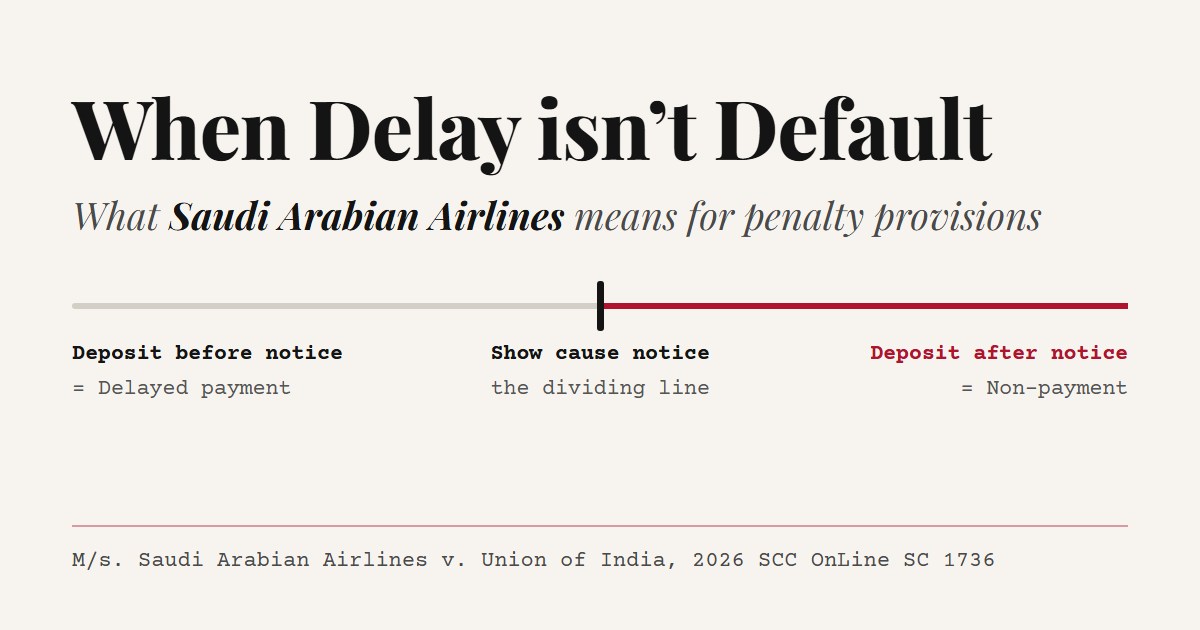
The most practically useful part of the judgment, in my mind, is that the Court drew the dividing line with the show cause notice. A deposit made before a show cause notice is delayed payment. A deposit made after it is non-payment. I like that it's administrable and gives taxpayers a clear incentive to regularise defaults before the department moves, and gives the department a clear point at which its penalty power under the “failure” provision crystallises. You don't need a fact-heavy inquiry into intent or circumstance just to work out which provision applies.
Mens rea is not the end of the discussion
This is where the judgment becomes interesting beyond its facts. The revenue's position, in essence, was that penalties of this kind need no proof of mens rea, so once the default is established, the penalty follows automatically. The Court accepted the first half of that proposition but rejected the second. Whether mens rea is required and whether penalty is automatic are two distinct questions. The first asks whether the department must prove a guilty mind, the second asks whether the authority must impose a penalty the moment a breach is found. Answering “no” to the first doesn't answer the second.
To answer the above the Hon'ble Court looked at the scheme first. The provisos to Rules 4 and 9 allowed condonation for sufficient cause and Rule 12 required notice, representation and hearing. A scheme like that presupposes a decision and ultimately there's no point hearing someone if the outcome is preordained and the power to impose a penalty includes the power not to impose it.
As for the statutory minimum, the Court put it neatly: a minimum governs quantum once penalty is found warranted, not whether it is warranted at all. That sentence is going to be quoted a lot. The penalty was set aside in full, with a refund carrying nine per cent interest. The Court also held that an appellant cannot be worse off for having appealed, which, given how ₹12,000 turned into ₹71 lakh on remand, was a point worth making.
Where this judgment won't help
I want to be careful here, because there's a temptation to cite a judgment like this everywhere, but unfortunately, it won't work everywhere. Some provisions expressly bracket delay, and they leave no room for this argument. Section 50(1) of the CGST Act imposes interest on tax not paid “within the period prescribed.” Section 122(1)(iii) speaks of tax deducted but paid “beyond a period of three months.” Section 201(1) of the Income Tax Act, 1961, separately lists one who “does not deduct, or does not pay, or after so deducting fails to pay.” Where the legislature has spelled out delay the Saudi Arabian Airlines reasoning simply doesn't apply.
Where it will
The judgment operates on provisions that speak only of failure. Section 271-C(1)(a) of the Income Tax Act is one. Section 276-B is another, and this is where I think things get genuinely interesting as the position there is already moving. A proviso effective 1 October 2024 bars prosecution where the tax is paid by the due date of the quarterly TDS statement. In Hemant Mahipatray Shah v. Anand Upadhyay2, prosecutions were quashed on the view that the section covers failure to pay and not mere delay.
But I'd be doing you a injustice if I didn't flag the obstacle. Madhumilan Syntex3 took the contrary view on Section 276-B, and it hasn't gone away. Anyone running this argument on that provision will have to deal with it head-on, not cite Saudi Arabian Airlines and hope the bench doesn't notice.
The GST angle
Finally, the discretion point which I think most matters in GST practice. Section 126 of the CGST Act requires penalty to be commensurate with the degree and severity of the breach. It sounds like a readymade discretion argument but it doesn't apply where the penalty is a fixed sum or a percentage and a lot of GST penalties are exactly that. So, in those cases, the argument has to rest on Section 75, which requires notice and an opportunity to be heard before penalty is imposed. This is where this judgment locates the discretion where a scheme that demands a hearing presupposes a real decision, and a real decision includes the option of not imposing a penalty at all.
My takeaway
The lesson I take from Saudi Arabian Airlines isn't really about Foreign Travel Tax, but about reading penalty provisions carefully and asking what conduct the words actually describe, and whether the legislature dealt with delay somewhere else. In addition, we must be vigilant to treat “no mens rea needed” and “penalty is automatic” as two separate claims, because the revenue will often run them together as if they were one because a ₹12,000 penalty became ₹71 lakh and every forum below let it stand until the Supreme Court asked those questions.